
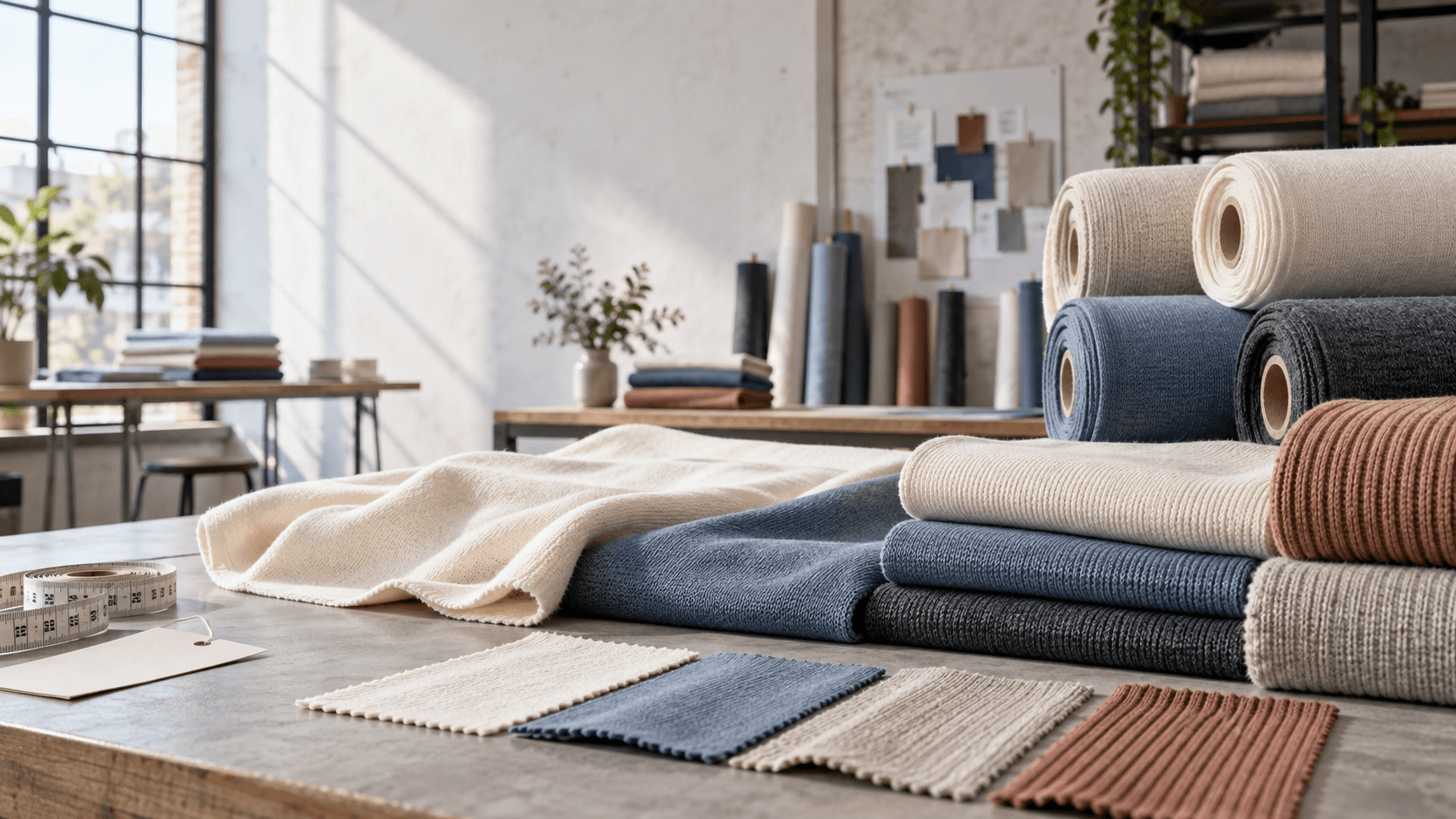
Choose for the silhouette and use
Cotton jersey without elastane offers a natural cotton hand and can work well for relaxed T-shirts, tops and other everyday garments. A cotton–elastane blend can provide additional stretch and recovery, which may be useful for a closer fit.
Neither option is universally better. The intended silhouette, wearer comfort, sewing method and care expectations should guide the choice.
Indicative fabric ranges
Cotton single jersey is commonly considered in a range of about 100–300 g/m² and 165–195 cm usable width. A cotton blend such as 94% cotton and 6% elastane may be considered around 250–300 g/m² and approximately 175 cm wide.
These are indicative ranges, not a guarantee for every construction or order. Confirm the exact composition, weight and width for the requested fabric and assess a production-representative sample.
Check how the fabric behaves
Look at stretch and recovery, drape, opacity, edge curling and how easily the material can be cut and sewn. For an elastane blend, pay particular attention to recovery after wear and washing.
Heat, washing and finishing may change the result. Test the fabric after the intended care process and, where fit is important, evaluate a sewn sample rather than relying on a flat swatch.
Define the production brief
Share the garment type, fit, target weight, colour, intended finish, print requirements, expected quantity and delivery date. Agree usable width, tolerances and sample approval before moving to a larger run.
Considering fabric and garment construction together helps reduce surprises in cutting, sewing and later use.