
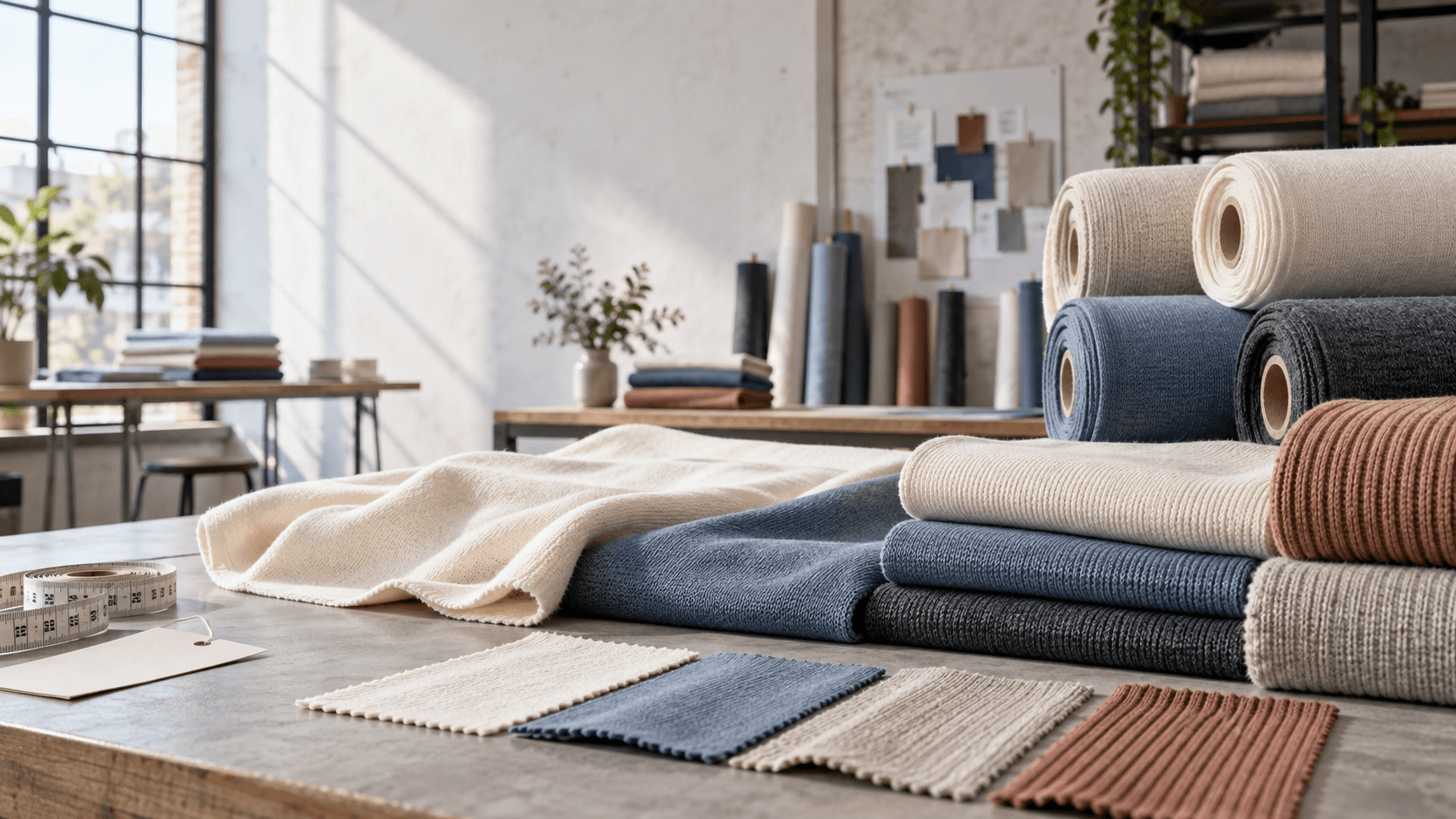
What is loopback sweatshirt fabric?
Loopback has a smooth face and a reverse with visible loops. Its reverse is more defined and less fluffy than a brushed surface, which can make it a versatile option for sweatshirts, joggers, shorts, children's clothing and streetwear. The feel also depends on weight, fibre blend, density and garment design.
For brands, “loopback” and “brushed” do not always mean two unrelated base constructions. Brushing is a surface-finishing process. When comparing offers, ask about the base knit, composition, weight before and after finishing, width and dimensional stability—not just the trade name.
What changes when a fabric is brushed?
Mechanical brushing raises and loosens fibres on the reverse, creating a soft, napped surface that can feel warmer because it holds more air next to the body. It is often considered for autumn/winter sweatshirts, joggers and loungewear.
The intensity of brushing can be adjusted to the desired effect. A fuller nap calls for checks for shedding, pilling, appearance after washing and changes in hand. One wash may not be enough to assess a garment intended for repeated use.
Compare the two options
- Reverse: visible loops versus a soft, raised surface. Decide whether the inside should look technical or fluffy.
- Thermal feel: loopback is often more versatile; brushed fabric usually feels warmer. Consider the season and whether the product is layered or worn on its own.
- Typical use: loopback for sweatshirts, shorts, trousers and year-round collections; brushed fabric for warm sweatshirts, joggers and autumn/winter or homewear.
- After washing: check loops, dimensions and surface on both; additionally inspect nap, shedding and pilling on brushed fabric.
- Printing and finishing: suitability depends on the face and stabilisation; include brushing in the agreed process sequence.
Weight is not the same as thickness
Weight describes mass per square metre, but not fullness or insulation on its own. Brushing can increase surface volume without a proportional change in mass; a dense, high-weight loopback can still feel substantial without a fluffy reverse. Compare grammage and tolerance, composition and yarn, usable width, loop density, brushing intensity, hand after softening/stabilisation, shrinkage after an agreed wash, and estimated yield for the marker.
For reference, the company's listed 100% cotton sweatshirt fabric is around 240–360 g/m², while diagonal sweatshirt fabric is around 330–500 g/m². Heavy diagonal with a loopback reverse may be heavier than some brushed options.
Choose composition and structure for the style
Cotton sweatshirt fabric offers a natural hand and suits many relaxed styles. A cotton–elastane option may be worth considering for close fits, narrow legs, children's products or areas that need to recover after stretching. The listed option is 94% cotton / 6% elastane at around 250–300 g/m²; elastane does not replace suitable pattern design, seams and stabilisation.
Diagonal sweatshirt fabric has a characteristic diagonal loop arrangement on the reverse and can suit heavier premium or streetwear garments. The listed range is around 330–500 g/m² in 100% cotton or 90% cotton / 10% polyester. Prototype the hood, rib and seams because the fabric weight affects drape, seam load and comfort.
Wash and test a prototype
Loopback may change hand or dimensions after washing. A brushed surface can mat, pill or release loose fibres. Test a sewn garment using a recorded care protocol; after each cycle, measure length and width, photograph the surface under the same lighting and assess seams, colour and softness.
For a useful brief, include garment and season, desired reverse, fibre blend and stretch, target weight and shape, colour/print/embroidery, care instructions, certificate requirements, quantity and delivery date. Order both options where possible and compare them in the same cut.