
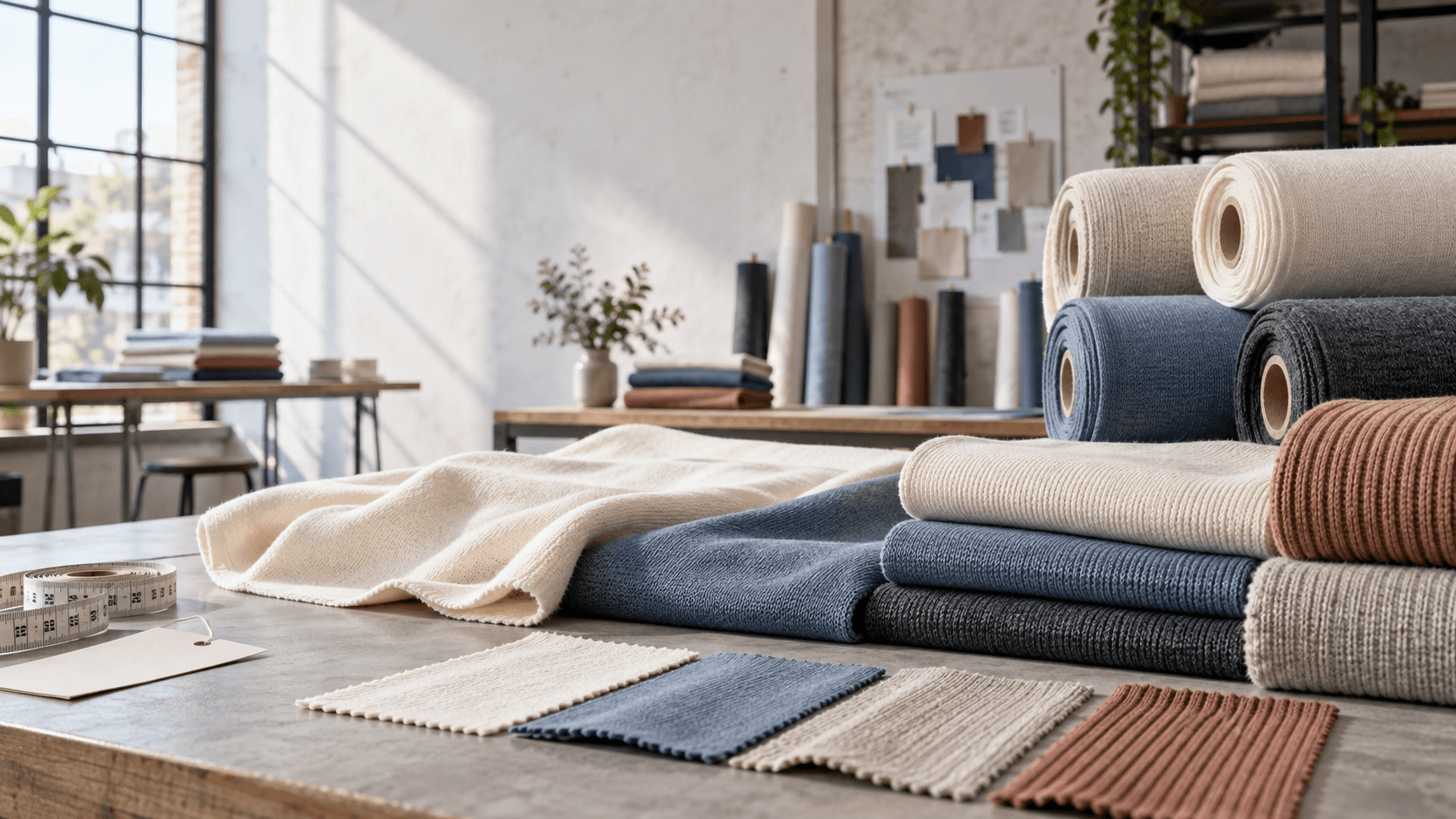
What is single jersey?
Single jersey is a weft-knit construction with two different sides: a smoother face and a reverse where the stitch structure is visible. It can drape and stretch more readily than double-faced constructions, which makes it useful for lighter garments, but parameters and stabilisation still need attention.
“Jersey” describes the knit construction, not a fibre. It can be made from cotton, viscose, synthetic fibres or blends. A complete specification should state both the construction and the composition.
Cotton or cotton with elastane?
Cotton can be a good starting point when natural hand, comfort and versatility are priorities. Elastane may help a closer-fitting garment recover after stretching, but it is not automatically better. It may be unnecessary in a loose T-shirt or pyjama and it changes stabilisation and sewing requirements. For a fitted top, cotton-only jersey may not provide the recovery the pattern needs.
- 100% cotton single jersey: offered around 100–300 g/m². Consider for T-shirts, long sleeves, pyjamas, nightwear and children's clothing. Check shrinkage, twist, show-through, print and hand after finishing.
- Cotton–elastane jersey: the listed blend is 94% cotton / 6% elastane, around 250–300 g/m². Consider for tops, leggings, close-fitting and children's styles. Check recovery, stabilisation, sewing and repeated-wash behaviour.
Choose weight for the product
There is no single best weight. Read g/m² together with composition, width, density, finishing and garment construction. Two fabrics with the same grammage can drape differently, feel different and yield different amounts of product. For T-shirts, a range around 140–220 g/m² is often explored, but it is not a substitute for sampling.
A lighter option may suit summer but needs opacity and stability checks. A heavier option may feel fuller while changing drape, thermal comfort and material consumption. Consider season, fit, colour—especially pale colours—print or finish, usable width and yield per kilogram, shrinkage, twist and the sewing method.
Check washing, printing and finishing
Post-wash behaviour depends on yarn, construction, stabilisation and finishing. Before approval, check not only dimensional change but also side-seam twist, surface, hand, colourfastness and print. A flat swatch shows appearance; a test garment gives more information about the finished product. Agree tolerances, wash under realistic conditions and measure again.
Single jersey can be prepared for dyeing, printing, stabilisation or softening. Match the process to composition, weight, absorbency, pattern repeat and the required result after washing. Test print on the intended base: the same artwork can behave differently on lightweight cotton and heavier elastane jersey.
When another construction may be a better choice
Do not choose single jersey only because it is popular. If the garment needs a more compact hand, similar appearance on both sides or greater stability, compare interlock. For warm sweatshirts and trousers, a sweatshirt knit may be more suitable. For specific insulation, abrasion, moisture-management or intensive-use requirements, define the performance brief and look at an appropriate construction rather than relying on the material name.
Prepare a short product brief
Share garment type and fit, preferred or excluded fibres, expected hand and weight, colour and planned print or finish, certificate requirements, expected order size and timing. Include a reference material or finished product if you have one. This helps compare options, request samples and identify parameters to confirm before production.